The Truth about Training
or
Finding the Right Trainer for You
- .
-
Can anyone train a horse?
-
-
Yes. And, anyone who touches and interacts with the horse trains it. Trains it to do what? Anyone who interacts with, leads, rides,
or feeds a horse, trains it to behave or not to behave in certain ways toward themselves and other people.
-
Can anyone train a horse to consistently behave in certain ways?
-
No. It requires a refined skill to make any horse perform unnatural behaviors. What are unnatural behaviors?
- .
-
Not spooking or not runinng when it is afraid.
-
Not to bite or not to kick
-
Being controlled with reins, hands and legs while being ridden
-
Being controlled while it is held by it's halter
-
Walking, trotting cantering or stopping on command
-
Holding its head down and its neck in a nicely arched, good looking frame when you ride it.
-
Standing still for the horse shoer or vet
You must understand, that when we train a horse we are asking it to act in an unnatural way. This is important to make the horse safe to be around.
Watch horses in nature, or in a pasture at feeding time. Learn what natural horse behavior is. We do not want our horses to behave as they behave in nature or as they behave with one another--bitting, pawing, kicking, rearing... We want them to be trained to be safe for us to handle, be around and to ride.
Training horses requires skill, experience and knowledge.
-
Can a good rider train a horse?
-
Sometimes yes, sometimes no. It depends on how many untrained horses the "good rider" has ridden.
Horses are born with a disposition that is much like our personalities. Some are more quiet and placid, some are more sensitive and reactive, some are more brave and curious, some are more fearful and reatreating.
Good riders look good on trained horses, and an untrained horse will make a good rider look poor. A good rider is not necessairily a good trainer. Looking good on a horse is very different than making a horse behave in certain ways.
Can anyone learn to train a horse?
No. Just like not everyone or anyone can be good enough to compete and win in the
Olympics, or to be on professional soccer, football and baseball teams. Not everyone will be able to have the skill to train a horse.
Should I try to train my own horse?
-
Only if it is already safe for what you want to do. If your horse is safe, meaning you are not likely to get hurt and the horse
is not likely to get hurt in what you want to do, then yes, learn to train your horse. Will you be as good as a professional trainer, probably not, but that is ok. Your horse is safe, and you can both continue to learn things together. Safety is the bottom line.
- How long does it take to train a horse?
- It takes many hours of handling, riding and working with a horse to
train it. I hear many people talk about their horses going out for 30
days training. If a horse is not trained, there is not much that will
happen in the first 30 days. Horses learn by repetition. It takes
at least 150 repetitions of a task for a horse to really learn that
task. That means, after you have asked a horse to walk by squeezing your
legs, and the horse has walked forward for about 150 times, it will probably
be trained to go forward at the walk. Will it be trained to pick up a
canter lead after this? No. The truth is it takes much longer to
finish a horse than what most people realize.
If you are not a trainer, then it is important for you to work with a
trainer. There are many subtleties to horses that are only learned by
working with and handling many horses. A person who has been working
with horses for only a few years just can not see many of the subtleties of horses,
unless that person were working with many horses for many hours a day during
that short time. There is no substitute for time and experience.
-
What if my horse is not safe?
Sell it, give it away or put it in training and wait for the trainer to tell you if the horse will be safe for you.
-
Can every horse be made safe for every person?
-
Not really. Some horses have dispostions that are difficult or have learned bad, unsafe behaviours that are difficult to change. Perhaps a professional trainer could make the horse safe for themselves, but that may not make the horse safe for you.
Find a trainer who is honest with you and in whom you trust. Follow that persons advice, unless you feel you would not be safe.
Which leads me to the last question:
What do you, or I, want in a
trainer?
First of all, you should ask yourself some questions, bearing in mind there may
not be a "right" answer, but merely a choice.
- Am I working on myself, on the horse, or on both. All can happen, or
you can work on individual parts. It is better to have clarity because
working on all three together is likely to take longer. Any changes in
you or your balance or style may seem punitive to the horse. In this
case, you want to progress slower. Not every horse has the temperment
of a school horse-- a horse that can tolerate the mistakes and learning
curve of the rider.
- Do I want to have input into the process or to take a leap of faith and
blindly trust another's opinions, expertise and experience?
Communicate, communicat, commucate. Some trainers do not want your
input, others are happy to hear and learn from your perspective.
First, know what you want. Then ask the trainer if that is how they work
with clients.
- How do I measure the trainer or the lesson? Is the horse more
relaxed than when he started? Is the horse closer to some defined goal at
the end of the lesson? Do we feel like we have had a small measure of
success with our position, our timing or our feel?
These are questions I think about. Because, yes, when I can afford it I
like to work with other trainers, especially those with more specific discipline
knowledge. Being a trainer, sometimes it is difficult to find a peer who
will dialogue with me. I will not give up or abdicate the values I have
about training or caring for my own horses. I have in the past, and now I
choose not to comprise my values, experience or "gut
feel". I am very willing to acknowledge different approaches,
and am willing to try most anything so long as it does not compromise my safety
or my horses safety. I do not need to be in a hurry and when I feel like I
am having trouble. I am happy with smaller improvements. I do not want to
be criticized when I am having trouble. I do not want to be
"shut-down" when I am asking questions.
Finding the right people to train and ride with is a tall order.
Physical Core Training
I often recieve email/promos promoting certain methods
One that particularly caught my attention was a video about "Core Fitness for Equestrians"
that promoted human physical fitness training as a way to "mimic" riding and train the riding muscles. I asked Jeffry Mathis, MA,(Jeffry.Mathis@evc.edu )a college instructor, to review the ad. Jeffry has been an instructor on training and training principles, as we as an avid on the ground fitness coach and trainer.
As a horse person, I couldn't have said it better.... It is so difficult to describe the forces that are applied to us as riders. I think this email from a reputable source explains why there is no substitue for riding to make riding muscles be fit!
what they are doing is extremely low-intensity[ ,... ]A horse is constantly moving, and, often, not smoothly, this constant moving and "shaking" causes a lateral loading that is not trained for in the controlled motion that they are doing in the video. In other words, riders don't fall because a horse is being good and moving perfectly forward; horses change direction, trip, stumble, are "lazy" with there feet. This is why people fall. This sudden shift changes the load that the body has to deal with. for example, if a horse just stands still, you are required only to deal with the load created by your body, and balance it on the horse. If a horse stumbles, the body must immediately be able to correct for this change in balance at a load greater than body weight. [approx a load of 1000lbs]
You can compare this to jumping. if you can squat with your own body weight, that's great, but any kind of jump training forces the body to deal with a much greater load (weight * gravity), and that load is moving, which makes it infinitely more difficult than just doing a regular body-weight squat.
If you train with slow, controlled squats (the horse advertising video) ,and are suddenly required to deal with jump squats (actually riding), you're still going to have trouble. You won't have as much trouble as someone who has been doing nothing, but there are better ways to train. The problem is that the better/best ways to train are not as easy as the cute little video.
.
amber@equestriantraining.com
Use the "Back" button on your browser to return to the homepage
|
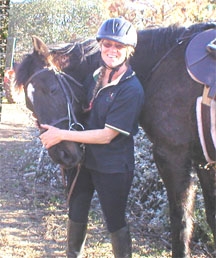 Me and BootZ